Rudyard Kipling"
“When you're left wounded on Afganistan's plains and
the women come out to cut up what remains, Just roll to your rifle
and blow out your brains,
And go to your God like a soldier”
General Douglas MacArthur"
“We are not retreating. We are advancing in another direction.”
“It is fatal to enter any war without the will to win it.” “Old soldiers never die; they just fade away.
“The soldier, above all other people, prays for peace, for he must suffer and be the deepest wounds and scars of war.”
“May God have mercy upon my enemies, because I won't .” “The object of war is not to die for your country but to make the other bastard die for his.
“Nobody ever defended, there is only attack and attack and attack some more.
“It is foolish and wrong to mourn the men who died. Rather we should thank God that such men lived.
The Soldier stood and faced God
Which must always come to pass
He hoped his shoes were shining
Just as bright as his brass
"Step forward you Soldier,
How shall I deal with you?
Have you always turned the other cheek?
To My Church have you been true?"
"No, Lord, I guess I ain't
Because those of us who carry guns
Can't always be a saint."
I've had to work on Sundays
And at times my talk was tough,
And sometimes I've been violent,
Because the world is awfully rough.
But, I never took a penny
That wasn't mine to keep.
Though I worked a lot of overtime
When the bills got just too steep,
The Soldier squared his shoulders and said
And I never passed a cry for help
Though at times I shook with fear,
And sometimes, God forgive me,
I've wept unmanly tears.
I know I don't deserve a place
Among the people here.
They never wanted me around
Except to calm their fears.
If you've a place for me here,
Lord, It needn't be so grand,
I never expected or had too much,
But if you don't, I'll understand."
There was silence all around the throne
Where the saints had often trod
As the Soldier waited quietly,
For the judgment of his God.
"Step forward now, you Soldier,
You've borne your burden well.
Walk peacefully on Heaven's streets,
You've done your time in Hell."
ISLAM - THE GREATEST THREAT TO THE WEST! Douglas Murray, Maajid Nawaz, Sam Harris, Weinstein's
Saturday, April 20, 2024
Maajid Nawaz, there are Muslims who will integrate into foreign cultures but only those who are non religious/secular Muslims much the same as secular Christians in The West have become.
Religious Muslims can not assimilate because assimilation is basically the same as Apostasy. Assimilation into Western “Infidel” Culture is not at all compatible with Islam and there is no getting around this dilemma. Muslims from every Islamic country immigrated to The West to escape tyranny, persecution, execution, poverty and deprivation.
They came to The West for freedom, economic opportunities and a higher standard of living than they had in their home countries. Now the 2nd and 3rd generations want Sharia Law and Jihad against The West. How can they be de-radicalized now? They have been born in The West, they are citizens of The West and they hate The West.
Immigrants must be coming to this country (and we must only accept people) because they love America, would fight for her, want to assimilate into her values, work hard, not take handouts, learn the language, accommodate us not the other way around, appreciate our generosity, thank us for the opportunity, don’t treat us like an ATM, recognize her greatness, have some gratitude, stop chanting “death to America.”
If you don’t like us that’s fine, but do it from the country you came from. You apparently don’t do it from the country you emigrated from because it’s not all that peachy.
Oh, and by the way, coming here…legally would be a really good start.
Is Anwar, Najib or the elite in charge of Malaysia? By Mariam Mokhtar
Malaysiakini : COMMENT | Successive Malaysian governments have five common traits. You can disagree or add to the list.
1. Everything is done at the last minute. There is little sense of urgency.
2. Exposés confirm a lack of transparency and fear of a public backlash.
3. Damage control means issuing statutory declarations or affidavits to expel doubts concerning the veracity of their side of the story.
4. If one has to fall, drag others down, too. No point in suffering alone.
5. The inevitable blame game. Stop being accountable for one’s actions.
Simply blame a higher order, and silence the rakyat into submission.
Who runs Malaysia? Is it Prime Minister Anwar Ibrahim, the convicted felon and former premier, Najib Abdul Razak, or the Malaysian elite?
The latest scandal to upend Malaysian politics is Najib’s claim that he is entitled to serve the rest of his prison term, under house arrest.
We worry about the cost of living crisis, and Middle East tensions escalating into global conflict, but we are dragged, once more, into reviewing Najib’s comfort.
The convicted felon wields greater influence in Umno-Baru than its president Ahmad Zahid Hamidi. He exercises power, by the ease with which he manipulates the coalition government, from the confines of his Kajang cell.
He has nothing to lose and everything to gain, by disrupting the Madani administration. He watches with glee, at Anwar’s response, or lack of.
Persistence works. Both his sentence and fine, have been steeply reduced.
R.Venugopal : PMX has shown his poor leadership in handling Najib’s pardon case and citizenship case. Both under Home Ministry’s ambit. Both the PM and Home Minister are ignorant or they are part of this problem. The should step down instead of giving excuses.
Najib’s crime was stealing public money and many cases pending and does he deserve a pardon in the first place. Now we have imprisonment changed to house arrest and the first it it’s kind in the nation.
Why waste judiciary time in issuing the judgement and let the pardon board make the sentencing.
Our nation’s image is badly damaged by such actions taken by the pardon board and the PM must take the responsibility. DAP which is part of the government should know this better and people should go to the polling station KKB elections.
It is time to kick out DAP as they are taking things for granted and you will be kicked out. Hope our YDPA shall intervene to put things right.
OCT : Anwar is a feel good PMX. He is not decisive for fear of losing power and position. Whatever he promised before GE are now forgotten, discarded, thrown out the window, and backtracked.
He prefers to voice out, support, show solidarity and go round the world to announce his commitments to Hamas and Palestinians who are of no concern to Malaysians while issues like 2R, food security, economy, depreciating RM, security back home were never resolved at all.
There was no deliverables whether it is the Gaza war or home problems resolved by Anwar. All the Rakyat hears is daily hot air from Anwar. He cannot rein in one of his party youth head for causing another May 13 but left it to the Agong to resolve it. No way the Rakyat will want another term of Anwar. He has failed miserably
Ignore negative voices in Kuala Kubu Baharu, says Yeoh By Shakira Buang
Malaysiakini : DAP vehemently rejects any attempt by certain parties to launch
a campaign to boycott Pakatan Harapan in the Kuala Kubu Baharu
by-election on May 11. The party’s assistant publicity secretary, Hannah Yeoh, said a boycott would be unproductive and harmful to the country.
“We
have to ignore negative voices like this. If you stay at home and do
not vote, this is not a productive action and is not good for the
country.
“It’s easy to talk but not to do work, it’s
better for us to work,” she told reporters after inaugurating the Jom
Gerak programme organised by Feminine Magazine at Taman Tasik Menjalara, Segambut, today.
Yeoh
was commenting on reports that several quarters comprising former
ministers, former Harapan leaders and allies, as well as NGO
representatives are holding meetings with local leaders and the Indian
community’s representatives urging for a boycott of the May 11 by-election.
Selangor
executive councillor V Papparaidu also confirmed the existence of an
attempt by certain parties to mobilise a campaign to boycott Harapan in
the by-election.This is after an NGO that once collaborated with Harapan openly asked Indian voters to spoil their votes in the upcoming polls.
Patriot Malaya : Hannah banana your party relies almost exclusively on NM support. Its the only reason why you are in power but the NMs are feeling betrayed because not only your party by PMX who also relies heavily on NM support are not at all bothered with voicing up for NM rights.
Its not hard at all to understand this. In fact it is blindingly obvious. While you might enjoy your pandering the bulk of NMs do not. In fact many MMs are upset at the direction of the country from radicalization to the poor economy and lack of reforms.
If you cant deliver on anything then why do you find it surprising that the base is turning on you. Not only the voters but the party grassroots are disgusted. We have said several times already better to withdraw from this UG and bide our time till the next election. Let PMX joking up with PN as he wishes and run the country deeper than 6 feet under.
Come the next GE the party can capitalize on the anger and frustration of voters. This is exactly how PH defeated BN in 2018. But for some reason you minister cluster just cannot see the big picture because of the perks and privileges that you enjoy.
Remember that BN would be in power even now if they had just kicked out Najib and embarked on some superficial reforms. The same thing is happening now. You are defending an indefensible PM and you will sink with him come the next GE. The hypocrisy being practiced cannot be justified.
ProMalaysia : I attended Bersih 2,3,4 and never missed a GE voting even needing to drive hundreds
of KM back to vote PH and was exuberant when AI sworn in as PMX thinking he will right the rots in Malaysia.
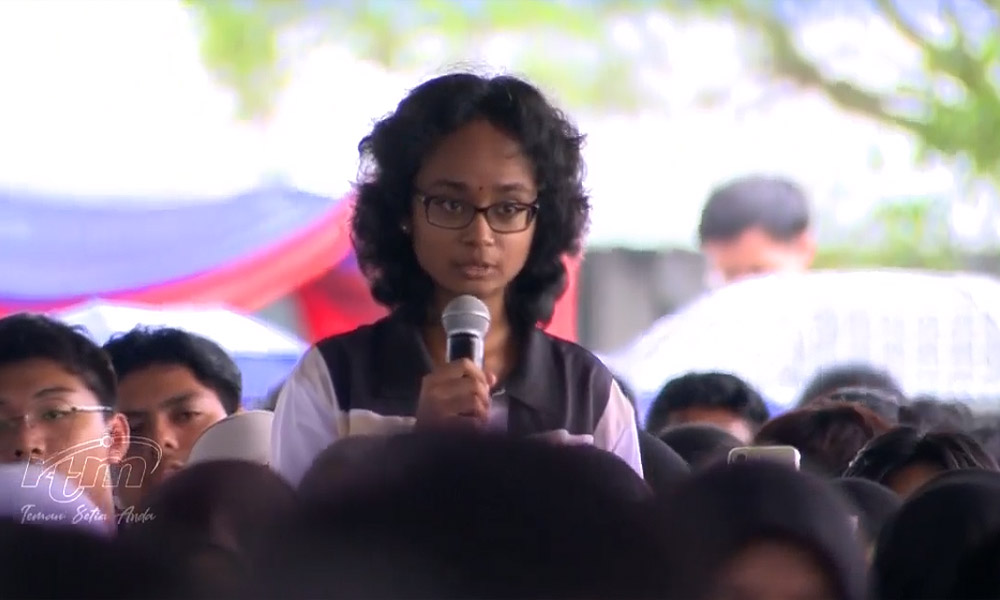
Looking at the last 15 months of PMX performance, I must say really disappointed with him…. He is becoming like a leader for Hamas interest instead of Malaysian… the worst of him is telling a young Indian student off when she asked to give non-Malays equal treatment…. Isn’t this what AI has been preaching all these years, and isn’t what the constitution demand.
Another case is the sock-gate. PMX and HM seem paralysed when confronted by Umno youth racial baiting….A simple case was allows to morphed into a racial incident. Two non-Malay was arrested and charged at lightning speed while the racist baiter was allowed to run amok and the vigilantes who broke the law was scot-free….
Shameful….
PMX ignored his faithful supporters and spend all his energy trying to win over his detractors …. Now he has lost his supporters and continue to be spurned by detractor he work so hard to win over.
KKB is the of many to come if he continues this path… he will lose Selangor state and can forget to get another term….
drngsc : Do your job Hannah.
Uphold your struggles for the people.
Recently DAP has forsaken the people, accept corruption and corrupt people, become very compromising to corrupt D-UMNO, and behave in un-DAP like ways.
So can you blame us for wanting to show you out frustrations with you? Teach you a lesson in KKB and hope that you realise your folly and return to your struggle.
Otherwise ( if you do not ), we will also sit out GE 16 and let you fall so that you will not forsake your principles and struggles, for which reason we fought with you to get you to where you are today.
PLEASE LEARN YOUR LESSON HANNAH, ANTHONY and DAP.
DSAI will fall in GE 16 if he continue to kiss the hands of D-UMNO.
PLEASE KICK D-UMNO OUT OF Unity Government. DSAI and DAP will be better without them.
"We're Forced To Believe A Lie", Douglas Murray DISMANTLES Islamists After Bishop Mar Mari Attack
Yes, but I don't think a single person believes that Islam is peaceful, not even Muslims.
You can take Islam out of the 7th century but you can’t take the 7th century out of Islam. Muslims view forgiveness as a weakness. Remember Lebanon once considered the Jewel of Arabia... that was so when Lebanon was Christian majority, but once Islam became the majority... judge for yourself?
And they inflict brutality on fellow Muslims so they won't be kind to other groups.
Join PVR Narasimha Rao and Vibhuti Jha as they engage in a thought-provoking discussion exploring the question: Are Hindus facing an existential threat? Understand the diverse perspectives, and deep analysis on this significant topic shaping contemporary discourse.
Sri Ramakrishna, Holy Mother Sarda Devi and Swami Vivekanandaji were born to protect and promote Hinduism. Hindus have become United under Shri Modi. Hindus are safe for about 1,000 years. Yes absolutely we are facing a threat .
It's because of ignorance of hindus living in posh gated colonies that they are unable to relate to the situation and plight of hindus living in M majority areas. Girls are so unsafe in M majorty areas.
I saw Four Muzlm boys on one bike harassing girls going to the temple. This is banal in India. But there is some hope because hindus are now being aware of what's coming as well.
Hindus have had a huge population so far throughout its history. However in next 10-15 years, we will be half of what we are now.
Douglas Murray Quickly SCHOOLS Muslim "Convert" and Leaves Room SPEECHLESS
I’m not religious but there should be no teachings of Muslim values in schools!! Why can Muslims denigrate Jesus and expect Christians to not argue and accept the criticism , but become violently angry when similar comments about Mohammad are made?
Rising Islamist Aggression: Anand Ranganathan Speaks on stone pelting on Hindu Ram Navami procession Intellectual Guy 88.8K subscribers
Friday, April 19, 2024
Rising Islamist Aggression: Anand Ranganathan Speaks on stone pelting on Hindu Ram Navami procession. Prepare to be shocked as Anand Ranganathan delves into the harrowing details of the recent attack on a Hindu procession during Ram Navami celebrations in Jharkhand's Bokaro district.
In this hard-hitting video, Ranganathan fearlessly confronts the uncomfortable truth of Islamist aggression against Hindus, recounting the brutal assault and stone-pelting that left several devotees injured.
As tensions escalate, Ranganathan unapologetically exposes the systemic persecution faced by Hindus during religious festivities, drawing parallels with previous incidents of violence across India. All mosques during the Muslim conquest, built over Hindu temples should be razed.
Amidst mounting concerns over communal harmony, he calls for decisive action to curb the menace of Islamist extremism and safeguard the rights of all religious communities.
Brace yourself for a provocative analysis that challenges conventional narratives and demands accountability from those responsible for orchestrating such heinous acts of violence.
LEAKED: Ivy League Professor Caught Telling Students to Start Violent Revolution - Muslim Professor Encourages Terrorism
Dave Rubin of “The Rubin Report” shares a DM clip of Columbia University’s visiting professor in modern Arab studies, Mohamed Abdou, being caught on camera indoctrinating students into violent revolution to combat settler colonialism.
This is an enemy within, have him arrested and banned. Feather and tar this enemy. Islam's goal is to take over (colonize) the entire world and but it under the thumb of Islam. Islam teaching our children the lies they grew up with. We’re supposed to be able to trust our teachers. Amazing how he doesn't tell all these gullible students about the Arab conquest of north Africa, Eurasia, the Levant, Iraq, Persia, Afghanistan, Indian sub continent.
Bishop Mar Mari Immanuel Breaks Silence, Sends Message
Bishop Mar Mari Emmanuel is still recovering, but he posted a powerful audio message. David Wood and the Apostate Prophet go through the message and react.
BENJAMIN NETANYAHU TELLS BIDEN: EITHER RAFAH OR IRAN - Harris Sultan
Harris Sultan in this insightful commentary on recent events. From the delicate balance of power in the Middle East to the implications of international relations, Harris delves into the latest developments with depth and nuance.
In this video, Harris discusses the implications of recent actions by Israel and Iran, shedding light on the intricate dynamics at play. Drawing on his analysis, Harris provides a critical examination of the motivations behind political decisions and their potential consequences.
Join Harris as he navigates through the intricacies of the Israeli-Iranian conflict, offering his perspective on the strategies employed by key players and their impact on the region. From diplomatic manoeuvres to military operations, Harris unpacks the complexities of the situation with clarity and insight.
Whether you're seeking to deepen your understanding of global affairs or simply curious about the latest headlines, this video offers valuable insights and thought-provoking commentary.
Don't miss out on this opportunity to gain a fresh perspective on the issues shaping our world today.
Sadhguru as he delves into the complex and contentious issue of historical temple destructions in India and the ongoing legal battles over religious sites. Explore the deeply rooted historical grievances that have shaped the cultural landscape of modern India, and hear Sadhguru's thoughts on how the nation can navigate its path forward amidst these longstanding disputes.
Historical Analysis and Contemporary Challenges: Sadhguru offers an in-depth discussion on the historical events that led to the destruction of thousands of temples in India, highlighting the impact of these actions on the Hindu community and the cultural heritage of the nation.
🏛️ The Gyanvapi Mosque Controversy: Gain insights into the current debate surrounding the Gyanvapi Mosque, a site claimed by Hindu petitioners to have originally been a temple destroyed during Mughal rule. Learn about the contrasting views and the legal intricacies involved in this dispute.
📜 Bridging Divides: Sadhguru emphasizes the importance of dialogue and mutual understanding between communities to resolve such sensitive issues. He advocates for a collaborative approach that respects the constitutional framework while acknowledging historical injustices.
🌐 Towards a Harmonious Future: Listen to Sadhguru's vision for India's future, where cooperative efforts lead to resolutions that strengthen the nation's social fabric and enhance its stature on the global stage.
🕊️ Call for Peace and Resolution: Explore how a balance of justice and reconciliation can pave the way for a unified approach to historical grievances, fostering peace and progress in Indian society.
The United States on Thursday (18 April) effectively stopped the United Nations from recognizing a Palestinian state by casting a veto in the Security Council to deny Palestinians full membership of the world body.
Euractiv : It vetoed a draft resolution that recommended to the 193-member UN
General Assembly that “the State of Palestine be admitted to membership”
of the UN Britain and Switzerland abstained, while the remaining 12
council members voted yes.
The result of the vote wasn’t a surprise. “The United States continues to strongly support a two-state
solution. This vote does not reflect opposition to Palestinian
statehood, but instead is an acknowledgment that it will only come from
direct negotiations between the parties,” Deputy US Ambassador to the UN
Robert Wood told the council.
Palestinian President Mahmoud Abbas condemned the US veto in a statement as “unfair, unethical, and unjustified.”
Palestinian UN Ambassador Riyad Mansour, at times emotional, told the
council after the vote: “The fact that this resolution did not pass
will not break our will and it will not defeat our determination. We
will not stop in our effort.”
The Palestinian push for full UN membership came six months into a
war between Israel and Palestinian militants Hamas in the Gaza Strip,
and as Israel is expanding settlements in the occupied West Bank, which
the UN considers to be illegal.
Israel’s Foreign Minister Israel Katz commended the United States for casting a veto.
A defiant Israel strikes Iran - Despite warnings to de-escalate from Western allies, an Israeli missile hit Iran.
The New States Man : Less than a week after Iran launched an
unprecedented drone and missile strike against Israel, Benjamin
Netanyahu has retaliated. Early on Friday (19 April), Israel hit Iranian
soil with a missile, according to unnamed US officials.
There have been early reports of explosions heard in Isfahan, a
central city and home to several Iranian military sites and an airbase.
It is also, notably, the centre of Iran’s nuclear programme. As former
US assistant secretary of state Mark Kimmitt told the BBC early on
Friday, “Isfahan really is to a great extent the centre of the Iranian
nuclear programme in terms of training, research and, what some would
say, the development of the Iranian nuclear capability… So it’s a likely
site that Israel would hit because the greatest fear the Israelis have
is not continued missiles today but a nuclear capability tomorrow.”
Iranian state media has downplayed the extent of the strike, claiming
that no damage has been reported in Isfahan. Tasnim news agency
published a video on Friday of an undisturbed site with the caption: “Isfahan’s nuclear site is completely safe.”
The strike comes after a week of diplomatic cajoling on the part of
Western officials, as the US, UK and others attempted to convince
Netanyahu and his agitated war cabinet not to escalate. During a meeting
this week with David Cameron, in which the UK Foreign Secretary urged
for a limited response to Iran, a defiant Netanyahu said that Israel
would “make its own decisions”. Joe Biden had also warned Netanyahu that
the US would not be participating in an offensive in the region and
advised that Israel should “take the win” following Iran’s thwarted
attack. After the strike on Friday morning, an unnamed US official told
CNN, “We didn’t endorse the response.”
When I said the people in MAT are stupid and ignorant of the law many people ( general and senior officers) are angry with me - Major Meor Rosli
Latest update from Maj Mior Rosli.
Above : Old Video 14 March 2024
We have won. The government ( including MAT) wants to appeal. I notice they have no substantive nor affirmative factual or legal grounds for appealing.
They are beating round the Bush with unreasonable and untrue facts to disagree with our claim.
During the open court hearing they gave reason that the vast difference of pension is because of basic academic qualifications
When they register for appeal they said they do not agree with all the judgement and order made by the High Court judge
When they submit their supporting affidavit they said inter alia :
a. We claim for "additional pension" and they refuse to give us additional pension. What we claimed was pension adjustment
b. They said that they cannot pay us because if they win the appeal, we will owe them and it would be difficult for them to collect back the money.
I replied that we are not beggers on the street.. we have monthly pension and they can always deduct from our monthly pensions.
c. This time they said they disagree partially with the judgment.
The supporting affidavit was signed under oath by mindef KSU on behalf of MAT and other defendents.
I have replied their affidavit and denied all their statements
In Parliament, menhan said (from the AG), in article 137(1) the wording which says the YDPA gave his general powers to MAT is wrong. And he goes on and says that article 41 must be read in harmony with article 132. To me all these are rubbish!
A41 states that the YDPA is the supreme commander of the Federation Armed Forces and A132 explain the types of public services.
When I said the people in MAT are stupid and ignorant of the law many people ( general and senior officers) are angry with me.. but it is true.
The case management will be on the 9th of May 2024. I hope the court will reject their appeal application.
I am going for roadshows after Raya to explain the situation and at the same time to explain to the non pensioners on how I am going to fight for them.
Kenapa orang luar negara gelar KLCC adalah simbol korupsi, ini ceritanya
Thursday, April 18, 2024
Gemilang Daily : Kenapa orang luar negara gelar KLCC adalah simbol korupsi, ini ceritanya. Mahathir
wewenangnya menggunakan kedudukannya sebagai Perdana Menteri
(1981-2003) untuk mengkayakan anak-anak dan kaum-kerabatnya melalui
projek-projek mega yang menggunakan wang kerajaan.
Antara
projek Mahathir yang didedahkan oleh Dr Roslan Latif, ialah projek
Menara Berkembar Petronas (KLCC) yang disangsikan telah mendapat
sokongan kabinet.
Sebidang tanah bekas padang lumba kuda telah dibeli oleh kroni
Mahathir, Ananda Krishnan dengan harga premium RM100 juta. Tanah
tersebut kemudiannya dijual kepada Petronas dengan harga RM600 juta
untuk kerajaan membina Menara Kembar Petronas yang merupakan menara
kembar tertinggi di dunia.
Di situ sahaja, Mahathir dan kroninya
Ananda Krishnan telah memperolehi keuntungan atas angin sebanyak RM500
juta yang juga merupakan satu rompakan halus terhadap Petronas sebanyak
RM500 juta.
Pihak
kroni Mahathir dan golongan yang menyokongnya membabi buta, melihat
Menara Kembar itu sebagai legasi besar Mahathir yang diagung-agungkan,
tetapi sebaliknya menara itu tidak memberikan apa-apa kebaikan kepada
rakyat.
Wang Petronas yang terkorban sejumlah RM600 juta itu
hanyalah perkiraan pada tanah tapak Menara Kembar itu sahaja, tetapi
belum lagi projek perancangan dan pembinaan menara itu yang pada mulanya
bernilai RM2.5 bilion.
Namun, dengan perompakan halus Mahathir,
setelah bangunan itu siap, anggaran harganya melonjak kepada RM7.5
bilion dan mungkin lebih daripada nilai itu. Nilai
pembinaan menara itu pastinya melibatkan perabot dan kosmetik yang
lain, dan memerlukan pihak lain untuk mengongsi keuntungan seperti
arkitek senibina, bahan binaan dan tenaga kerja.
‘Menara Satu’ daripada entiti struktur Menara Kembar Petronas itu adalah milik ipar Mahathir, Ghazali Mohd Ali. ‘Manara Dua’ adalah milik General Hashim Mohd Ali, juga merupakan ipar Mahathir.
Projek
lantai (atau flooring) seluruh menara diberikan kepada syarikat Prime
Granite milik anak Mahathir, Mokhzani yang bernilai RM 470 juta.
In the last few weeks and months, we have seen a pretty dramatic rise in Anti-India racism. It seems that social media platforms like Twitter are encouraging such behaviour against Indians by trending such racism. In this video, we have talked about this and tried to find out why this is happening.
First they ignore you, then they mock you, then they fight you, and then you win. Once in a Sydney Bar an Australian told me you Indians should be greatful having accounts of most of your ancestors and we Australians are like stray dogs who barely even know their Grandparents as our ancestors are all mixed and scattered.. Made me really proud to be an Indian.
I have travelled to 80 countries so far. As an young person of 30, I have overwhelmingly encountered positive sentiments, and affirmations of admiration for the way India has evolved. Somehow, social media portrayals and the opinions on the ground in most of these nations are worlds apart.
Another problem is that some people from Pak, Ban, and Afg are doing obnoxious things by declaring themselves as Indians abroad.
After conviction quashed, ex-technician charged again By Hidir Reduan Abdul Rashid
Malaysiakini : Former technician Chiok Wai Loong was charged again in the Kuala
Lumpur Session Court over the alleged comments on the controversial
socks with the word Allah after the High Court quashed his sentence
earlier today.
Before Sessions Court judge Siti Aminah Ghazali
this afternoon, the 35-year-old accused pleaded not guilty over the
charge under Section 233(1)(a) of the Communications and Multimedia Act
1998.
The lower court then set bail of RM5,000 in one surety and
set May 23 for mention of the case. His family was seen at the bail
counter of the Kuala Lumpur Courts Complex this afternoon to arrange the
posting of bail and his release. Previously
on March 22, Chiok pleaded guilty to the charge, which was read to him
before another Sessions Court judge, Suzana Hussin.
Chiok had
admitted to making the offensive comments on Facebook and apologised,
saying he did not do it on purpose. He was then convicted and sentenced
to six months in jail and fined RM12,000. He was not represented by any
lawyers at the time.
However, upon Chiok having secured legal
representation from lawyers Latheefa Koya and N Surendran, the Kuala
Lumpur High Court earlier today allowed the accused's review application
to quash the conviction and sentence.
Unclear, unconditional, inadmissible
apanama is back : So previously the case was undertaken hastily? Overzealous? By the way, the vigilantes in this case are scot free. Wonderful!
karma : What happened to these so-called influencers that were supposed to be arrested?
Steven Ong : '' ,,, joking that the socks with the word Allah printed on them should be welcomed as it meant the person wearing it has Allah’s protection “from head to toe”. ''
Only brainless man would take this comment as disrespectful or insulting.
Its a joke but it could also mean a sober view on the sock issue. Actually many on earth who believed in the God and gods do this by hanging or sticking verses or pictures or placing figurines from their scriptures and gods in their house, cars and lorries. believing that it may bring divine protection from their gods.
The prosecution must prove beyond doubt that it was an intention to insult and not a joke or misunderstanding. Going into a temple area and damaging figurines of god is purely an intention of disrespect, hatred and violent act . The punishment should be 3 times more severe than this sock issue.
Some people just never learn and believed that others must respect them but do not think its necessary for them to respect others . The clear failure of religious teachings and education.
GrayPanther0439 : What happened to the fire bombers and perpetrators of halal meat fiasco ?
GreenDeer3623 : Still no news about the lorry driver who destroyed a place of worship?
One person jokingly telling ppl the sock issue is not a big deal, he doesn't harm anyone doesn't damage any property, merely voicing his own opinion from a NM point of view.
One is intentionally destroyed place of worship, while recording video and post on Internet.
Anon25 : He had only pleaded guilty to making those statements. The Malay Sessions court judge quickly convicted and fined him because Akmal was screaming that NMs had insulted God.
After that with some NM voices being raised especially from Sarawak the authorities seem to have had second thoughts.
The HC has correctly ruled that there was never any intent to insult anybody.
Hence there never was any crime. So the lower court judgement was correctly set aside.
But why the need for another trial in a new Sessions court?
The Pulltea Guy : WHY WERE THE VIGILANTES who confronted him not charged for criminal intimidation? Does that mean anyone can threaten people in the name od "defending" the religion???
What Chiok said was sarcastic but could be argued as fair comment..Some Turkish Ottoman Sultans wore clothes with holy verses written as protection.
Mano : "Previously, Chiok apologised after being confronted by an influencer silat instructor and his friends. His personal details were also circulated across social media."
What has Saifuddin , Anwar , PRDM done to this influencer and his friends??
Oh, can anyone enforce their own set of laws??
Woman suspected of wheeling dead man to bank to withdraw loan detained by police in Brazil
7 News : Bank attendants were alarmed as the woman allegedly propped up the corpse.
WARNING: Distressing content
A
woman suspected of wheeling a dead man, who she said was her uncle, to a
bank to withdraw a four-figure loan has been detained by police in Brazil.
Footage
of the woman at the bank has sparked a nationwide discussion in Brazil
after going viral on social media. It appears to show the woman at the
counter of a Rio de Janeiro branch of Itau Bank, propping up the head of
an elderly man in a wheelchair and trying to get his hand to clasp a
pen.
According to police, she
was attempting to take out a loan equivalent to A$4,600, which had
already been approved by the bank but still needed the elderly man to
sign off.
But the
elderly man in the video – filmed by a bank attendant – remains
unresponsive. His arm is limp, and his head keeps falling back as she
talks to him. “Uncle,
are you listening?” she asks him. “You need to sign. If you don’t sign,
there’s no way. I can’t sign for you, it has to be you. What I can do, I
do.”
“Sign it so you
don’t give me any more headaches, having to go to the registry office. I
can’t take it anymore,” the woman continues.
A tale of two leaders Anwar Ibrahim and Javier Milei By Murray Hunter
Murray Hunter : For 25 years, the people believed Anwar Ibrahim would bring reforms to Malaysia. Pakatan Harapan came to power with a pledge to focus upon the economy. Now Malaysians are looking at a situation, where non-Malays perceive they have no meaningful place.
After nearly 18 months in office, Prime minister Anwar appears to be continuing the same agenda he carried out while deputy prime minister back in the 1990s. Back in the 1990s, Anwar Islamized the government, and played a major role, alongside his former boss Mahathir Mohamed, nurturing crony capitalism in the country.
Over the last 25 years, Anwar has portrayed himself as a reformer.
Today, Anwar oversees a nation plagued with vigilantism, religious inspired violence, terrorism, and the rapid advancement of crony capitalism in the economy. To make matters even worse, the Anwar government is embarking upon the most draconian censorship and loss of freedom of speech, the nation has ever seen.
In Malaysia, any hopes of reform have gone down the drain.
In contrast, Argentina’s new president Javier Milei, who pushed back on the World Economic Forum in person, at Davos last January, is trying to radically change the nature of his country’s economy. The libertarian and economist Milei presented a sweeping agenda to overhaul the economy and rid the nation of the ‘deep state’ within the bureaucracy.
Milei has quickly acted to shrink the size of the bureaucracy, cutting ministries from 18 to 9 in the government. Milei is reducing public spending by 5 percent of GDP, while putting an end to subsidies at the same time. A large number of public tenders have been cancelled in an attempt to eliminate corruption. Milei is also on the road to privatising Argentina’s state owned companies to free up the economy and make it much more competitive.
Regulations are being slashed at unprecedented rates.
Although there is much congressional and provincial governor resistance through court challenges to Milei’s measures, he is attempting to crash through these barriers, or risk crashing himself. Milei hopes to break up the political forces that control Argentina, a country with 161 percent inflation, and 45 percent of the people live in poverty.
Milei has a small team of ministers in contrast to Anwar’s 38 senior ministers, not including deputies. The Milei government has an economic-libertarian bias. While Anwar came to power with a similar philosophy, the government has been on the authoritarian side, maintaining much of the regulatory framework in place, and has heavily supported existing monopolies and government linked companies (GLCs).
In addition, the Anwar government is pursuing an Islamization objective.
There are challenges ahead for both Anwar and Milei. Foreign investors are closely watching the paths and outcomes of both countries. Both leaders have disapproval ratings at present, and the lynchpin to both leaders’ survival will greatly depend upon economic performance.
Anwar is running his government on record deficits, while Milei is keeping hyperinflation down by achieving a fiscal surplus after 3 months in office. Milei is Dollarizing the economy in an attempt to stabilize inflation. Dollarization, could well be used as a short-term method to stabilize the Ringgit, in lieu of pegging the Ringgit to the US Dollar.
Once the threat to the Ringgit has passed, Malaysia may be wise to speed up the ASEAN proposed payment connectivity scheme, where the Ringgit can be exchanged with other currencies, without using the US Dollar and a medium of comparison.
The greatest contrast between Anwar and Milei is that Anwar is trying to preserve the existing class system.
While Milei is trying to rid the nation of those who exercise great power behind closed doors within the bureaucracy and GLCs.
There is no doubt fearless leadership of a nation is needed in these times. Milei has attacked the structural aspects of the economy that matter for a democratic country to exist.
Anwar hasn’t touched upon any of the deep structural problems of the economy, which will maintain the existing class system.
PM's ex-aide Farhash is the new political crony By P Gunasegaram
Malaysiakini : COMMENT | There’s a new corporate
name in town, Farhash Wafa Salvador Rizal Mubarak, Prime Minister Anwar
Ibrahim’s former political secretary, now associated with listed
technology player HeiTech Padu Bhd.
HeiTech Padu is now a rising
star, fast winning large contracts and seems poised to win an RM1
billion Immigration Department IT contract as well.
The game is
old though, finessed by Umno Baru of patronage, intermediaries, and
contracts given indiscriminately to those connected - never mind their
ability - so long as they have the right links with the right people.
The
new part is that there is a political operative from within PKR whose
only claim to corporate ability, despite limited vague experiences for
over a decade in the corporate arena, is connections - that may be new
for a PKR politician.
MS : Put it simply, the fellow is a proxy for the the Man who does not want a salary.
Concernedpatient : true. because the salary is peanuts to him lol. this is the real deal
KK Voter : The disturbing question: Is this new unity government led by PKR operating no differently from Umno and Bersatu in the award of contracts? You need to ask?
Common Man : Old Game New Faces !
The Unity Govt and BN Govt are twins ..
And DAP in 10 years would be gone just like MCA and GERAKAN
apanama is back : "Is this new unity government led by PKR operating no differently from Umno and Bersatu in the award of contracts?"
Oh, a BIG yes! UMNO Baru DNA is everywhere within the unity government.
The current administration is UNITED to ensure crony capitalism stays alive, 'dulu, kini dan selamanya.'
Next, who will be joining this 'skim durian runtuh?'
BLADE HORROR Teen Sydney ‘terrorist’ had finger sliced off during stabbing of Bishop Mar Mari Emmanuel as church calls for calm
The Sun : THE teen "terrorist" who ruthlessly stabbed a bishopin Sydney is said to have had his finger sliced off during the attack and ensuing church melee.
The Christ The Good Shepherd Church in Wakeley where the horrors
unfolded have called for people to not seek "vengeance and justice" on
the attacker. Instead, asking for people to "adopt the spirit of humility, love and peace" to support the wounded bishop.
Harrowing
footage of the attack shows several churchgoers leaping to Bishop
Emmanuel's rescue by ripping off and disarming the boy. The suspect was pinned to the ground as he grinned manically to himself on Monday evening inside the church.
It is now believed that during the life-saving scuffle the young perpetrator "had one of his fingers severed". Police think his finger could've been torn off by accident as he was bravely apprehended by parishioners, say news.com.au.
Police Commissioner Karen Webb said it was “too early to say” how his finger was ripped off. She continued: “It is not clear yet whether it’s self-inflicted or through the melee that occurred or some other way."
The real mass-terrorism in the Australian attack of an Assyrian Bishop, was by the media
Vlad Tepes : In yesterday’s attack of a Bishop in a Sydney Church, we all know now
that it was a Muslim yelling Allah hu ackbar. But as per usual, the
media did two things that amount to terrorism as much or more than the
attack itself.
In the case of MSN.News, and somewhat the Daily Mail as well, they
deflected from the actual crime of attempting to kill someone by
stabbing them several times in the chest, to explaining that the victim
had unacceptable views to nice people. Non-Narrative views. He was, to
quote the MSN, an “Anti-vaxxer” and was against the LBTQ movement, or
“community” as they call it, as if they all hung out together and play
bridge.
[…] He is the leader of an ultra-conservative branch
of the Assyrian Orthodox faith who has a big presence on social media,
with 17,000 followers on Facebook and 200,000 subscribers on YouTube.
Videos he has posted to TikTok have been viewed millions of times.
In July 2021, at the height of the pandemic, he described lockdown restrictions as “mass slavery”.
He claimed that the risks posed by Covid-19 had been “exaggerated” and that vaccines were unnecessary because people’s natural immune systems would fight the virus.
Yes, truth means your
an ultra-conservative extremist. But communists would say that. Again,
the real metric is revolutionaries Vs. Counter-revolutionaries. And his
views are counter revolutionary. But all this is just my opinion so far.
This is more interesting:
In the video above, the sound was deleted during the attack. They
took time and effort to remove the evidence that it was an Islamic
attack against anything Muslims don’t want said, and engaged in
deflection so you would have in your head, the impression that he was
anti-LGBTQ and anti-Covid measures so either he was worthy of death of
you don’t agree with those views, or he was killed for those reasons.
Meanwhile on Twitter, many version of the attack exist where you hear
the attacker yelling Allah hu ackbar. This makes the media terrorists.
This is not even an op ed or a spin. This is the deliberate
falsification of crucial evidence for the purpose of making sure the
public has the wrong idea about an important event, so they cannot make
healthy decisions for themselves based on reality, or even be allowed to
feel appropriately about the event.
The DM did similarly although I don’t know if they used a doctored video:
Yesterday, there was information which was viral that the “angry mob” of Christians outside the church had cut off the attacker’s fingers, when in fact he sliced off one of his own fingers when people removed the knife from his hand after he stabbed the Bishop.
Here is an 8 minute video course on dialectics about the attack apparently.
If it was an exam, write down all the dialectical dodges of the video to create a false impression of the event. See how many you can find. For those that get them all, the prize is the ability to think clearly. That’s better than a new car.
At this point, trust none of what you read from the MSM, at least in the last 4 years and remember, the architects of this are not stupid. They put people out front and centre of the counter-revolution to make damn sure we never get in front of the narrative attacks.
We could use the term, “Controlled-Opposition” but that deserves its own little mini essay as it means too many things to be used in the single case. It has become dismissive, and yet another tool to make us do their work for them.
Just give every less fortunate, deserving Indian child scholarship By Commander S THAYAPARAN (Retired) Royal Malaysian Navy
Anwar Ibrahim Bullying Young Indian Student
Malaysiakini : “I do not want that our loyalty as Indians should be in the slightest
way affected by any competitive loyalty whether that loyalty arises out
of our religion, out of our culture or out of our language. I want all
people to be Indians first, Indian last, and nothing else but Indians.” -
Bhimrao Ramji Ambedkar, Writings And Speeches: A Ready Reference Manual
COMMENT
| Here is the thing. When we are talking about the Indian community, we
are talking about a specific section of the Indian community.
Really,
I have no interest in the petit bourgeoisie or bourgeois class of the
Indian community and their so-called issues which are intimately linked
with the compromises they have made with mainstream political parties.
You
want to know how to help the Indian community, dear leader? Well, how
about giving every academically deserving underprivileged Indian child
an educational opportunity?
All
these cash programmes Prime Minister Anwar Ibrahim mentioned in his
recent speech at the BR Ambedkar International Convention and Ambedkar’s
133rd birth anniversary celebration are the kind of cash handouts that
have not worked for decades and indeed only encourage the kind of
bureaucratic malfeasance and feudalism that further injure the Indian
community.
The only poverty alleviation programmes that have
worked are those that ensure that young underprivileged children get an
education and that they have proper school facilities and a stable home
environment.
Why do you think young Indian student activists are
begging the government to ensure that underprivileged Indian children
have a fair deal when it comes to educational opportunities?
Not
only do they have to face the horse manure “pull yourself up by your
bootstraps” nonsense from another minority community which controls the
private education system in this country, they have to deal with a
system which targets them simply because they are poor and from a
minority which does not have much political and economic clout.
When
Anwar arrogantly dismissed that young Indian woman (ironic because the
prime minister said of BR Ambedkar “His commitment to women’s rights was
a primary concern”), what he was really doing was silencing the voice
of the underprivileged that he claims he wants to champion.
GreenLion2218 : Dear Misquoted
I would think that it would be a good start to 'Just give every less fortunate, deserving Indian child scholarship'. Period - and on the presumtion that this will indeed occur.
We can talk about 'deserving child' later.
With regards to your magnanimity, I would encourage you to learn up on the Indian plight in this country (from the 1800s for example) to understand what the Commander istrying to say. And, if I may add, the man has put it as plainly as possible.
Who shall we vote for : i disagree. scholarship and govt handouts is only for those connected and rich parents children.
“Radicalized Youth” - Assyrian Bishop Mari Mari Emmanuel Survives Stabbing Attack In Australia
Bishop Mar Mari Emmanuel got stabbed during a church service that was live-streamed from Sydney on Monday. He's famous on social media with followers everywhere, but some people disagree with his preaching. Bishop Mari Mari remains in critical condition.
I'm a Romanian Orthodox and I love Bishop Mar Mari, praying for a quick recovery. I am Ethiopian Orthodox and we love our brother Bishop Mar Mari teachings. God bless him and his recovery. I'm traditional Non Novus Ordo Latin Rite Catholic and I love Bishop Mar Mari Emmanuel. He is a true servant warrior of God and not afraid to tell the truth. He is like a living St. Michael the Archangel.
God Bless you, Assyrian Bishop Mar Mari, I am praying for you. As far as the Christian Emergency Meeting, select family members and I have already had that meeting, we have one at the beginning of every year, and we are set to make more babies, Catholic, conservative, traditional values, successful and non-corruptible. I have a teenage daughter in a Private Catholic school, and will have more.
My brother has 2, set for more. The future is conservative values.
99.8% of Muslims Don't Know Allah Says THIS about the Bible!
In the Quran, Allah affirms the inspiration, preservation, and authority of the Bible. But the Quran contradicts the Bible on fundamental doctrines. What should we conclude? Welcome to the Islamic Dilemma!
I know several ex-Muslims who know all this material and it is why they converted - and why they can't return to their own country. I was in a taxi in Istanbul. Many taxi drivers when noticing a foreigner want to share Islam with you. The driver began the usual “I’m a Muslim and we believe in the final book/prophet, the Bible has been changed, we love Jesus too…” I discussed this same dilemma in the Quran, namely the Quran confirms the Torah and the Gospel to which he agreed.
Then I told him that the Quran states that whatever scriptures Allah sends to his people he will protect. Then I asked the taxi driver how is it possible that Allah didn’t protect his other scriptures from corruption according to Muslims? The driver sat in silence for 5 minutes and then looked at me and said “that’s a great question! Why would Allah allow the Gospel to be changed?!”
You need a Christian to explain Islam better. Quite an irony. God bless your family and Ministry
Bishop Mar Mari Emmanuel SHOCKS Muslims with Warning from Afterlife
Spawn Of Satan
Bishop Mar Mari Emmanuel appeared on the PBD Podcast and showed how Jesus is completely different from other prophets in Islam. The uniqueness of Christ only makes sense from a Christian perspective. Read Quran 3:45 and believe. There were Assyrians, Serbs, Macedonians, Greeks, Russians all last night ready to put life on the line for our Bishop
Jesus is the reason Mari Emmanuel is alive his strength saved him Amen. Protestant here. Anyone risking their life for Christ is my brother, regardless of denomination! As a Scottish Presbyterian, I wish Bishop Mar Mari Emmanuel a speedy recovery after the unwarranted physical attack on him.
Former Christian atheist here. (coming from APs channel haha) I'm deeply touched by Bishop still preaching forgiveness, and love after everything. Christianity is unique in how much it emphasises love forgiveness and humility. I have always loved that.
Satan raises the sword, Christ raised the cross. Satan takes lives, Christ, gave His own. This tells me who the real ONE is.
Bishop Mar Mari Emmanuel, on YouTube as @followersofchrist_ , was attacked during a live stream. Here is more to the story, and what it means for Christians.
Let's pray for this Bishop, and also for the attacker. We pray that God will restore the Bishop physically, and the attacker spiritually. We pray the best for them both. Who else but a Christian would pray for his attacker ? As a member of the Assyrian Community, I'm very happy to say both His Grace Mar Mari Emmanuel and Father Isaac are in stable conditions in the hospital. May God's justice prevail and all evil be struck down.
The Pseudo-Secularism in India - Sanitising History in India
In a thought-provoking discussion on the future of India and Hindus, This talk highlights the contrasting views of the two authors. While one author's book instils hope for a mature dharmic state and India's rise, the other author's book presents a fearsome case for Hindus.
In the context of the celebrated Pran Pratistha at the Ayodhya Ram Mandir and PM Modi's potential comeback, one can find here a discussion of various topics related to Indian politics, including the future of the Hindu community, the Modi government's stance on Hinduism, the Kashmiri Hindu Exodus, the problem of leftist rhetoric and hypocrisy, the geopolitical impact of the Modi government, the role of history and its interpretation by leftists, and the concept of secularism in India.
Let us understand here how Nehruvian secularism is a farce and true secularism lies in the civilizational ethos of India.
How fcuking stupid can the Aussies be? - Smirking Sydney 'terrorist' was released on 'good behaviour' for knife crime before church stabbing
Shocking video captured moments after a knifeman unleashed on a bishop in Sydney shows the alleged attacker grinning from ear to ear. The 15-year-old boy smiled eerily at a camera as he lay pinned to the floor of a church by several brave witnesses and a police officer.
Well-known bishop Mar Mari Emmanuel was stabbed on Monday night, about 7pm local time, as he preached to his congregation at Christ The Good Shepherd Church in Wakeley. This is cold blooded smooth criminal behavior nothing related to good behavior
At least four people were stabbed in the swift and brutal knife attack.
It was the second mass stabbing to hit Sydney in just 48 hours, after 40-year-old Joel Cauchi carried out a senseless rampage at a Bondi Junction shopping centre and killed six people. Why blur his face???? Let the public see him!!! A coward attacks defenceless people!!!
They don't want him to be killed, to be released later for another stabbing attack.
India: Unprecedented barbarity, numerous jihad attacks throughout the past month By Ashlyn Davis
Robert Spencer : Non-Muslims are not spared Islamic violence throughout the year, but
during the “holy” month of the Muslims, the violence becomes more
rampant. Things have not been different in India, either. In one
instance, a Muslim mob beat up a Hindu man for playing devotional songs
in his shop because “it’s namaz time,” and in another, a group of
Muslims stuffed snacks with inedible elements. The killings and
murderous attacks remain constant.
On April 3, the Maharashtra Chief of “Akhil Bharatiya Sant Samiti,
Dharma Samaj” (All India Saint Committee, Dharma Samaj) and Mahant
Peethadhishwar, Dr Aniket Shastri Maharaj, was attacked
by 1000 Muslims. The incident occurred near the Nashik highway around 1
a.m. The frenzied mob targeted his vehicle, kicked it, struck it with
sticks, and shattered its windows. The assailants also wreaked havoc on
other cars passing by, vandalizing them indiscriminately. The Maharaj
and his companions escaped the assault by navigating their vehicle
through a narrow alleyway.
Again, on April 5, Muslims in Nashik, baying for the blood of a Hindu
boy, went on a rampage, vandalizing buses and vehicles on the roads.
They raised the infamous “Sar Tan Se Juda” slogan (“Separate the head
from the body”) against the boy, accusing him of making derogatory
comments about the Islamic prophet Mohammad; the violent crowd demanded
the death penalty for the boy. However, it turned out that the Hindu boy
had made the alleged comments only in response to derogatory remarks
that Muslims had made about Lord Ram. As per reports, the Hindu boy
posted about his preparation for Ram Navami on a popular picture-sharing
platform, and Muslims swarmed his posts, leaving objectionable remarks
about the Hindu deity. The Hindu boy’s response led to the violence.
The Hindus witness Muslims using profanities and expletives for
deities online and in the real world all through the year. They overlook
such instances in most cases, while in some of these instances, Hindu
associations file a legal case. Crowd violence has always been an
Islamic tactic to corner the forgiving and welcoming community and keep
it in fear and terror.
This latest spate of Islamic violence didn’t end with the mayhem in
Nashik. On April 7, Vikas Saini, a Hindu youth from Uttar Pradesh’s (UP)
Bulandshahr, was attacked
by several members of the notorious Qureshi family, which boasts a
lengthy criminal history. The victim’s family has alleged that the
assaulters, identified as Abu Nasar, Shaukeen, and Ajaib, are known for
harassing Hindus regularly and being involved in several illegal
activities. As per reports, Vikas was carrying cash worth 13,000 rupees
($155) on the day of the incident. The attackers pounced upon him,
pinned him to the ground, and robbed him of his money. They didn’t just
beat him, but almost killed him by pouring boiling oil on him. Subhash,
another Hindu youth who leaped to rescue Vikas, also suffered severe
burns from the hot oil.
We have previously covered
the news that five miscreants were booked after condoms, gutkha, and
stones were allegedly found in samosas supplied to an automobile company
in Pune, Maharashtra. The accused, identified as Rahim Shaikh, Azhar
Shaikh, Mazhar Shaikh, Firoz Shaikh, and Vicky Shaikh, have been charged
with placing this material into the samosas.
In other news from Vadodara, Gujarat, seven Muslims were arrested
on charges of feeding beef-stuffed samosas to Hindus; the proprietor of
the shop was among the accused individuals. The local Crime Branch,
acting on a tip-off, conducted a raid and confiscated 113 kg of beef
from “Hussaini Samosa.”
It is universally known that Hindus don’t consume beef for religious
reasons (with a few exceptions among left-leaning groups). Selling beef
samosas under the guise of selling regular meat samosas was an act of
betrayal. This act could have prompted communal violence as well, but
the Hindus chose to ignore this heinous treachery, trusting the
authorities to take appropriate legal action. One can only imagine what
this could have transpired into had a Hindu shop fed pork to the
Muslims.
While such Muslims act on their barbaric instincts, their eminent propagandists are exasperated
at seeing media houses cover Muslim-on-Hindu crimes. They accuse the
media of targeting Muslims by covering stories where Muslims have either
deceived or killed the Hindus. Often, dedicated Islamic apologists enter journalism solely to
whitewash the criminal acts of their coreligionists; they thus find it
frustrating that other journalists expose Islamic violence.
They desire
an India where these Islamic jihadis run wild attacking people, and the
media refuses to report on them, while government and law enforcement
officials shy away from penalizing them — an India that is inching
toward the much-desired Gazwa-e-Hind.
With two stabbings occuring within 72 hours, Sydney-siders are in a panic. 7 News shares the latest details on both Saturday's Bondi Junction stabbings and yesterday's church stabbings. The Pussy Aussie Police and the Pussy Aussie Politicians are being politically correct.
Civil court quashes Catholic woman's conversion to Islam By Hidir Reduan Abdul Rashid - Escapee
Malaysiakini : A Sabahan Catholic
succeeded in her legal bid to nullify her conversion to Islam two years
ago, following a breakdown in her relationship with a Muslim man who
initially promised to marry her.
The 21-year-old’s lawyer Shamsher Singh Thind confirmed that the Penang High Court allowed her judicial review application. According
to court documents, the woman from the Murut ethnic group pointed out
that her conversion to Islam - at age 17 on June 11, 2020, at the office
of Pertubuhan Penyebaran Islam Antarabangsa Pulau Pinang - was invalid
as it was done without the consent of her Catholic parents.
The
woman, who was baptised by her parents at a Catholic church in Keningau,
Sabah, on Aug 28, 2005, said her agreement to be registered as a muallaf
(new convert to Islam) was only given because her then-boyfriend
informed her that the procedure was necessary so that they could have a
legitimate marriage.
She noted that when she agreed to be registered as a muallaf, she was yet to turn 18, which only happened later on Nov 22, 2020. “I confirm that around February 2022, I broke off relations with my boyfriend and did not marry him.
“I
confirm that following the breaking off of relations with my boyfriend,
and until April 25, 2023, I tried several times to cancel my
registration as a muallaf but was informed by several syarie lawyers that this was impossible.
“This
was because Section 113(1) of the Administration of the Religion of
Islam (State of Penang) Enactment 2004 acknowledges me as a Muslim
forever,” said the woman who was born in Keningau on Nov 22, 2002.
However,
judge Quay Chew Soon in today’s ruling allowed the woman’s bid to quash
her Islamic conversion, pointing out that Section 117(b) of the same
state enactment requires consent from both her parents before she could
be converted as she was a minor at the time.
The court not only
ruled that the woman, who now works as a waitress at a restaurant in
Penang, is still a Catholic but that her registration as a muallaf was invalid from the onset. Quay also ordered the two respondents - Penang’s Islamic Council and the state muallaf registrar - to remove her name and details from the registry.